In short
- Move the vehicle as far left as you safely can, hazard lights on.
- Get everyone out on the left-hand side and behind a barrier if there is one.
- If anyone is in danger or injured, call 999 first.
- Note your road, direction of travel and nearest landmark or junction.
- Call recovery with your location, vehicle, whether it rolls and steers, and your destination.
1. Make yourself safe first
Nothing about the vehicle matters more than the people in it. As soon as you realise something is wrong, move as far to the left as you safely can — onto the hard shoulder on a motorway, or well off the carriageway elsewhere — and switch your hazard warning lights on. If it is dark or visibility is poor, leave your sidelights on too.
Get everyone out of the vehicle using the doors on the left, away from passing traffic, and move behind a safety barrier if there is one. Keep children close and animals inside the vehicle. On a motorway, wait well away from the carriageway and never attempt repairs yourself, even for something that looks simple.
If anyone is injured, or you are in a dangerous position and cannot get to safety, call 999 first. Recovery comes after the emergency services.
Broken down now? Call 07944 597463
2. Gather the details recovery needs
A recovery operator can only help quickly if they know exactly where you are and what they are collecting. Before you call, have these ready:
- Your location: the road name or number, which direction you were travelling, and the nearest junction, town or landmark. On motorways, note the numbers on the small driver location signs along the hard shoulder.
- The vehicle: make, model and registration.
- Its condition: whether the engine runs, whether the vehicle will roll, and whether the steering works. This decides how it will be loaded.
- The destination: where you want the vehicle taken — home, a garage, or somewhere else.
- Who is with the vehicle: and a phone number you can be reached on.
3. Roadside repair or full recovery?
Some faults can be fixed at the roadside; many cannot. If the vehicle will not start, will not roll, has accident damage, or the fault is electrical or mechanical and not obvious, the practical option is usually recovery: the vehicle is loaded onto a tilt-and-slide bed and taken where it needs to go, rather than repaired where it stopped.
Recovery also covers planned moves that are not breakdowns at all — a car you have bought, a vehicle going to a workshop, or one that has been off the road. The loading is the same; only the urgency differs.
4. How vehicle recovery works, step by step
- You call. You describe where you are, the vehicle, its condition and where it is going.
- The price and next steps are agreed. With SK Recovery, the price is confirmed upfront, with no hidden charges, before the truck sets off.
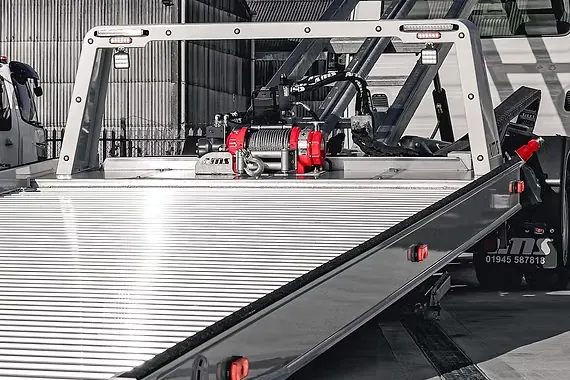
- The vehicle is loaded. A tilt-and-slide bed lowers to a shallow angle. Running vehicles can be driven on; non-runners are pulled on with a hydraulic winch. The vehicle is then secured for the journey.
- It is transported. Your vehicle travels on the bed, covered by goods in transit and on-hook insurance, and you can call the same number at any time for an update.
- It is unloaded at your destination. Home, garage, workshop or storage — wherever you agreed.
5. What affects the price of recovery?
Recovery prices are not fixed tariffs, because no two jobs are identical. Quotes are normally based on:
- Distance — where the vehicle is, and how far it has to travel.
- The vehicle — its size and type, from a family car to a light commercial or small plant.
- Its condition — a runner that drives onto the bed is simpler than a non-runner with locked steering or accident damage.
- Access — a vehicle on an open road is quicker to load than one in a tight car park or down a narrow track.
- Timing — when the job needs to happen.
Whatever operator you use, agree the full price before the truck rolls, and confirm there are no additional charges on top.
6. Motorways, accidents and non-runners
On a motorway
Pull onto the hard shoulder as far left as possible, hazards on, everyone out on the left and behind the barrier. Use the emergency telephone if one is nearby, or call from a safe place. Never cross the carriageway and never attempt a repair.
After an accident
If anyone is injured, call 999. When it is safe, exchange details with anyone else involved and take photographs of the scene and damage if you can. Your insurer may arrange recovery, but you can also arrange your own and keep the details for your claim.
If the vehicle will not roll or steer
Say so when you call. A tilt-and-slide with a winch is designed for non-runners, but loading a vehicle with locked steering or badly damaged wheels takes more care, and the operator will plan for it.
7. Questions to ask any recovery operator
- Is the price you have quoted the full price, agreed before you set off?
- Can you take a non-runner, and a vehicle that will not steer?
- Is my vehicle insured while it is on your truck?
- Where exactly will you take it, and can I get updates while it is moving?
- Who will I be speaking to if I need to call back?
Common questions
How quickly can recovery reach me?
It depends on where you are and where the nearest available truck is. When you call SK Recovery, we confirm the next steps and timing with you before setting off, and you can call the same number at any time for an update.
Can you recover a vehicle with no keys, or locked steering?
Usually, yes — tell us when you call. Winch loading is designed for vehicles that cannot be driven, but locked steering and missing keys affect how the vehicle is loaded, so the operator needs to know in advance.
Can I travel with my vehicle?
Ask when you book. What is possible depends on the job, the vehicle and seating available, so agree it during the call rather than at the roadside.
Do you only cover London?
No. SK Recovery is based in London and operates across the whole UK, 24 hours a day.
Is my vehicle insured on the truck?
Yes. Every load SK Recovery carries is covered by goods in transit and on-hook insurance from the moment the vehicle is secured until it is unloaded.
Need recovery now?
Call 07944 597463 at any time, day or night. For a planned move instead, request a quote and we will reply with a price.