In short
- Stop gently, keep a firm grip, and park somewhere safe, flat and away from traffic.
- Never change a wheel on a motorway or anywhere traffic passes close by.
- Many cars now carry sealant or run-flat tyres instead of a spare — know which yours has before you need it.
- Sealant and run-flats are get-you-home measures with limits; the tyre still needs professional attention.
- The UK minimum legal tread depth is 1.6mm — but grip falls away well before the legal limit.
1. First: stop safely
A puncture may announce itself with a bang, a drumming noise, heavy steering or the car pulling to one side. Slow down gradually — no sharp braking — keep a firm grip on the wheel, and pull over somewhere safe, level and well away from traffic. Hazards on. On a motorway, get onto the hard shoulder as far left as possible, everyone out on the left and behind the barrier, exactly as in our breakdown guide. Your safety assessment comes before any thought of the wheel.
2. Spare, sealant or run-flat?
- Full-size or space-saver spare: a real wheel change. Space-savers are temporary, with speed and distance limits marked on the wheel.
- Sealant and compressor kit: seals small tread punctures and re-inflates the tyre so you can drive gently to a tyre fitter. It will not fix sidewall damage, a torn tyre or a damaged wheel.
- Run-flat tyres: let you continue for a limited distance at reduced speed after losing pressure — again, straight to a fitter, and the tyre is usually finished afterwards.
- Nothing at all: some cars carry none of the above. Then your options are a mobile tyre service or recovery.
Check tonight, in your driveway, which of these your car actually has. Discovering it on a wet hard shoulder is the worst possible time.
3. Changing a wheel: the safety rules
- Only attempt it on firm, level ground, well away from moving traffic. Never on a motorway, and never with any part of you under a car supported only by a jack.
- Handbrake on, engine off, automatics in Park, and passengers out and clear.
- Follow your handbook for jacking points and sequence — they are model-specific.
- Tighten wheel nuts in a star pattern, and re-check them as soon as you can afterwards.
- Respect the space-saver's limits, and get the punctured tyre inspected promptly.
If any of that cannot be done safely where you are, the correct decision is not to do it. Wheels can be replaced; people cannot.
4. When the tyre cannot be saved
Sidewall cuts and bulges, a cracked or bent wheel, a tyre that has run flat for any distance, or damage from a pothole strike all mean the tyre is finished and driving on it risks a blowout. Sealant will not help. The vehicle needs a tyre fitter's visit or recovery on a truck — which also protects a damaged wheel and suspension from further harm. Photograph pothole damage if you can do so safely; it may matter for a claim.
Stranded with a flat? Call 07944 597463
5. Preventing punctures
- Check pressures regularly, including the spare — wrong pressures wear tyres and invite damage. Your car's correct pressures are on a sticker in the door shut, fuel flap or handbook.
- Check tread: the UK legal minimum is 1.6mm across the central three-quarters of the tyre, but wet grip deteriorates well before that. The edge of a 20p coin is a handy rough gauge.
- Look for cuts, bulges, nails and uneven wear whenever you check pressures.
- Slow down for potholes and debris where it is safe to do so.
6. When to call for help
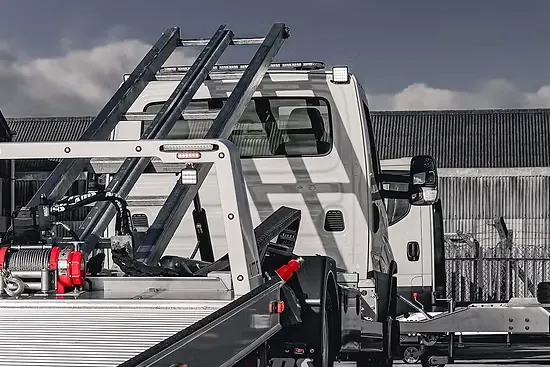
Call if you are anywhere unsafe, if you have no spare or the sealant cannot work, if a wheel nut or jack defeats you, or if the wheel or suspension may be damaged. SK Recovery will load the vehicle without driving on the damaged tyre and take you to a fitter, home or a garage. See roadside recovery for how it works.
Common questions
Can I drive slowly on a flat tyre?
Only for the shortest distance needed to reach safety, and expect the tyre — possibly the wheel — to be ruined by it. Never continue a journey on a flat standard tyre.
Does tyre sealant ruin the tyre?
Sealant is a temporary repair for small tread punctures. A fitter will need to inspect and clean the tyre, and many punctures repaired with sealant still need a proper repair or replacement.
How far can I go on a space-saver spare?
Follow the limits marked on the wheel — space-savers are restricted in both speed and distance and are only for reaching a fitter.
Is 1.6mm tread really enough?
It is the legal minimum, not a target. Wet braking and grip fall significantly as tread wears, so most drivers replace tyres well before the limit.
Can you take my car to a tyre fitter?
Yes. We recover vehicles with tyre and wheel damage to a fitter, garage or home address anywhere in the UK.
Flat tyre and not safe to change it?
Call 07944 597463. Be ready for next time with our breakdown kit guide.